
Drupal and Zero Waste Marketing: Leave No Good Content Behind
Most organizations don't have a content shortage. They have a content waste problem.
A product description gets written for the website, then recreated for a sales sheet. Customer data lives in Salesforce but never makes the website smarter. A webinar disappears after the event. A great case study gets published once, shared twice and quietly buried beneath six months of newer content.
Meanwhile, marketing teams are being asked to produce more content, more campaigns, more personalization, more channels and more measurable results.
What if the better answer isn't simply creating more? What if it's wasting less?
At BigTuna Interactive, we've been a big fan of the Zero Waste Marketing movement: building a marketing ecosystem where good content, useful data and valuable customer interactions can be reused, connected and improved instead of constantly recreated. I don't know who created the phrase first but they are on to some good stuff!
Drupal is particularly good at making that possible. Its structured content model, taxonomy, APIs and integration capabilities allow a good Drupal agency to become more than the place where your website pages live.
It can become the connective tissue of your marketing stack. The ultimate alignment between the sales and marketing teams is zero waste marketing.
What Is Zero Waste Marketing?
Zero Waste Marketing is the idea that valuable marketing assets shouldn't have a one-and-done lifespan. Create something valuable once, then structure your systems so that value can travel.
A customer story can become a case study, industry page, sales resource, social post and supporting proof point. A webinar can become a video, article, FAQ, email campaign, resource page and searchable knowledge asset.
Product information shouldn't need to be manually rewritten every time it appears on another part of your website. Customer data collected through your website shouldn't disappear into one system while your marketing team works from another.
And insights from analytics shouldn't sit in a dashboard without influencing what gets improved next.
The goal isn't to publish the same thing everywhere. It's to create a smarter content and data ecosystem where nothing useful gets unnecessarily thrown away.
Why Drupal Works So Well for Zero Waste Marketing
Drupal's real power isn't simply that it allows you to publish pages. It's that Drupal thinks in structured content.
Instead of treating every webpage as an isolated document, Drupal can break information into reusable pieces: content types, fields, taxonomy, relationships, media and structured data. That changes what's possible.
Imagine a manufacturer with hundreds of products. A traditional approach might involve manually placing the same product information across product pages, industry pages, dealer pages, comparison tools and downloadable resources.
With the right Drupal architecture, that information can be structured once and reused throughout the website. Update the source information and every experience pulling from it can stay current.
That's Zero Waste Marketing in practice.
You're not just saving time. You're creating a more reliable source of truth.
Your Best Content Shouldn't Disappear Into the Archive
Marketing teams spend significant time and money creating useful content. Then something strange happens: they publish it and immediately start working on the next thing.
Six months later, an excellent article may be sitting twelve pages deep in the blog while the organization is paying someone to create another article about almost the same subject.
Zero Waste Marketing asks a different question:
What valuable content do we already have, and how can we make it work harder?
Drupal's taxonomy and content relationships make it possible to organize content around topics, industries, products, audiences and stages of the customer journey. Instead of creating a chronological pile of articles, you can build interconnected topic clusters.
A strong article about an industry can support an industry landing page. A technical resource can surface alongside the product it discusses. A case study can appear automatically wherever the customer's challenge is relevant. An FAQ can answer a question on multiple pages without maintaining multiple copies.
Good content shouldn't be buried simply because it's old.
If it's still useful, keep putting it to work.
Connect Drupal to the Rest of Your Marketing Stack
Content reuse is only half of the Zero Waste Marketing equation. The other half is data and utilizing the systems that Sales and IT already have in place.
For many organizations, the website has become an island surrounded by other systems. Salesforce knows something. The website knows something else. The email platform has another piece. Analytics has the behavioral data, while a product database holds operational information.
Then people bridge the gaps with spreadsheets, exports and manual data entry.
That's expensive waste.
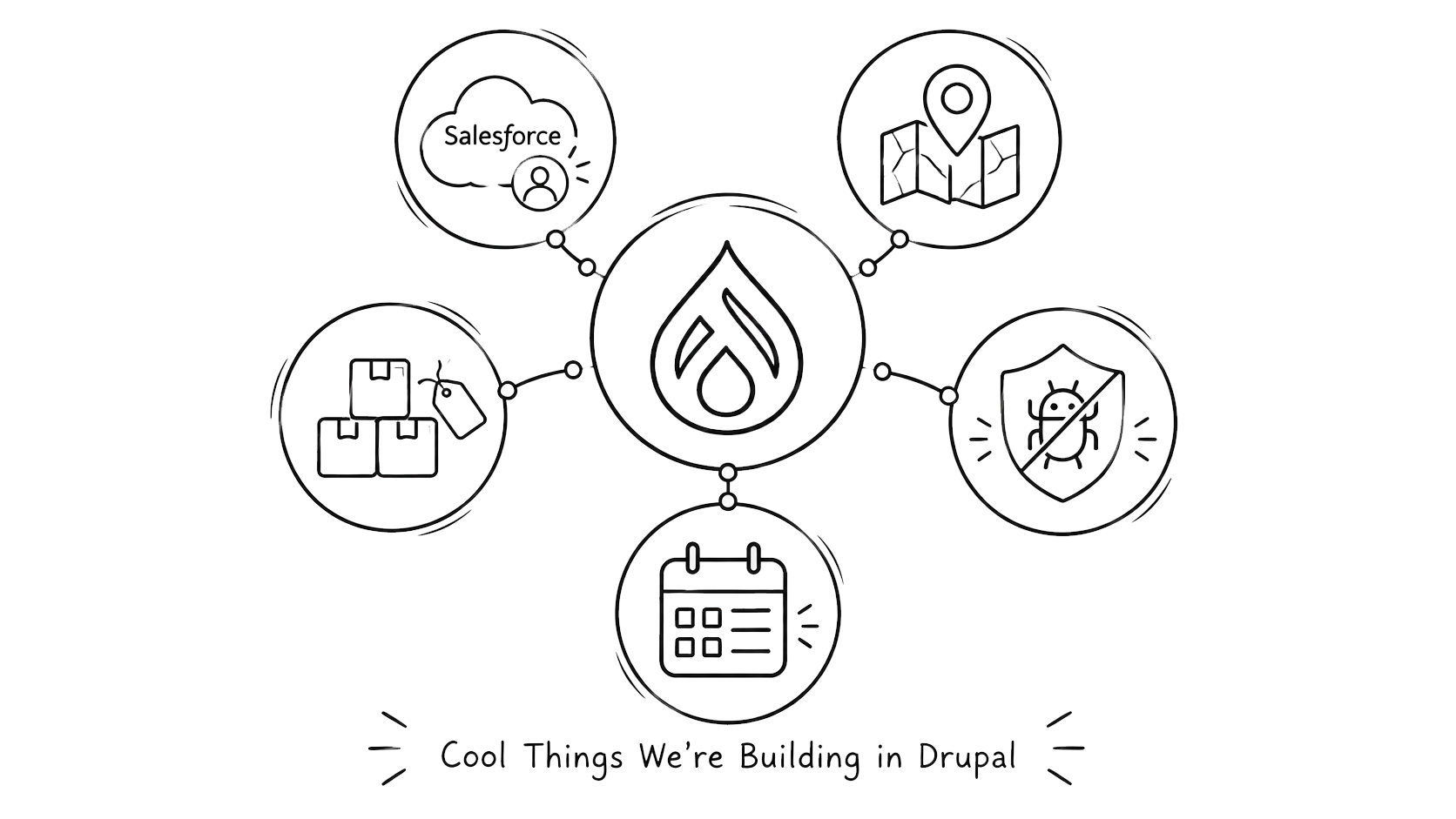
Drupal's APIs and extensible architecture make it well suited for connecting those systems. At BigTuna, we've built integrations between websites and platforms such as Salesforce where website activity can create and update leads, contacts, cases, custom objects and other business information.
But the more interesting opportunity is often what happens in the other direction.
What does your CRM already know that could make the website more useful? What product information could be synchronized instead of manually entered? What customer interactions could trigger a smarter follow-up?
And what data are employees typing twice because two systems aren't talking?
Every unnecessary handoff is an opportunity to remove waste.
Drupal + Salesforce: A Good Example
Imagine someone visits your website and submits a detailed request.
The simplest implementation emails somebody. A slightly better implementation creates a Salesforce lead. But the workflow doesn't necessarily have to stop there.
Depending on the business process, Drupal and Salesforce can exchange information about:
- Leads
- Contacts
- Accounts
- Cases
- Opportunities
- Custom objects
- Product selections
- Locations
- Uploaded documents
- Customer status
- Form activity
Complex integrations can also use queues and background processing so data moves reliably without slowing down the customer's experience.
Now your website isn't merely generating leads. It's participating in a larger business process.
That's where marketing technology becomes especially powerful. The website stops being a digital brochure and starts functioning as part of the organization.
Stop Recreating Data You Already Own
Organizations often have surprisingly valuable information hiding in operational systems: dealer information, locations, product specifications, customer categories, inventory, certifications, service areas, events, training resources and sales information.
The marketing website frequently needs some of that information. But instead of connecting systems, organizations create another database and start maintaining another copy.
Eventually, the copies disagree.
Zero Waste Marketing looks for opportunities to establish a source of truth and let Drupal consume, display or enrich that information.
Sometimes Drupal should own the data. Sometimes Salesforce should. Sometimes an ERP, PIM or another business system should.
The important question isn't:
“Can we put this in Drupal?”
It's:
“Where should this information live, and how should the rest of our systems use it?”
That's a very different way to think about web development.
Turn One Piece of Content Into a Content Ecosystem
Zero Waste Marketing also changes how content is planned.
Take a webinar. The traditional workflow might look like this:
Promote webinar → host webinar → upload recording → move on.
Instead, think about everything contained inside it.
One webinar could produce:
- The original webinar
- A video library entry
- A written recap
- Several short video clips
- Expert quotes
- FAQs
- Social content
- Email content
- Sales enablement material
- Related resources
- A topic-cluster article
- New insights for an existing service page
Drupal can provide the structure connecting those pieces.
A webinar about Drupal migrations, for example, doesn't have to disappear onto a webinar archive page. It can strengthen your Drupal migration page, surface beside related articles, appear within a Drupal resource center and support the larger topic cluster.
One idea becomes an ecosystem instead of a disposable asset.
Zero Waste Marketing Is Also an SEO Strategy
This approach has another major advantage: it creates better websites for search.
Instead of publishing isolated articles and hoping Google discovers a relationship between them, Drupal can help create deliberate content clusters around the subjects where your organization has genuine expertise.
A primary service page can connect to supporting educational content, FAQs, case studies, related services, technical resources, customer stories, videos and industry applications.
Those relationships help users explore the subject more deeply and make your expertise easier for search engines to understand.
The goal isn't producing 100 articles because an SEO tool generated 100 keywords.
It's building the best collection of useful information around the subjects that matter to your business.
That's a much more durable SEO strategy.
AI Makes Content Reuse More Important, Not Less
Generative AI has dramatically lowered the cost of producing words.
It has not lowered the cost of producing expertise.
That distinction matters.
The web is rapidly filling with interchangeable content that technically answers a search query but says very little. Organizations already possess something much harder to manufacture: their own experience.
Customer questions, technical knowledge, sales conversations, case studies, product expertise, webinars, research, internal documentation and subject matter experts can all become valuable marketing assets.
The Zero Waste Marketing opportunity is to capture that knowledge, structure it and reuse it intelligently.
AI can help transform and distribute the material. But the raw ingredient should still be something worth saying.
Don't use AI simply to make more content.
Use technology to get more value from the expertise you already have.
Your Website Should Learn From Your Marketing
Zero Waste Marketing isn't only about publishing. It's also about feedback.
Analytics can show which content attracts visitors. Search data can reveal the questions customers are asking. CRM data can help identify which inquiries become opportunities, while sales and customer-service teams can tell you what objections and confusion they encounter repeatedly.
That information should eventually find its way back into the website.
Maybe an FAQ needs to be added. Maybe a high-performing article deserves to become a larger topic cluster. Maybe customers consistently ask for something that's buried three levels deep in your navigation.
Or maybe a service page generates traffic but never generates qualified leads.
Marketing shouldn't be a conveyor belt where content goes out one side and nobody looks backward.
The system should learn.
Drupal Should Be Part of the Marketing Stack, Not Just the Website
This is ultimately where we think Drupal becomes most valuable.
Drupal isn't just a CMS sitting at the edge of your technology stack. Done well, it can become the layer connecting content, customers and business systems.
Your CRM shouldn't be isolated from your website. Your analytics shouldn't be isolated from your content strategy. Your best customer stories shouldn't be isolated inside a case study library.
And your product information shouldn't be recreated every time marketing needs it somewhere new.
Connect the pieces. Structure the information. Reuse what deserves another life. Measure what happens, then improve it.
That's Zero Waste Marketing.
Create good things. Connect them intelligently. Leave no good content behind.